Trinity Campus in Permian Basin will test direct air capture, store CO2 by 2026
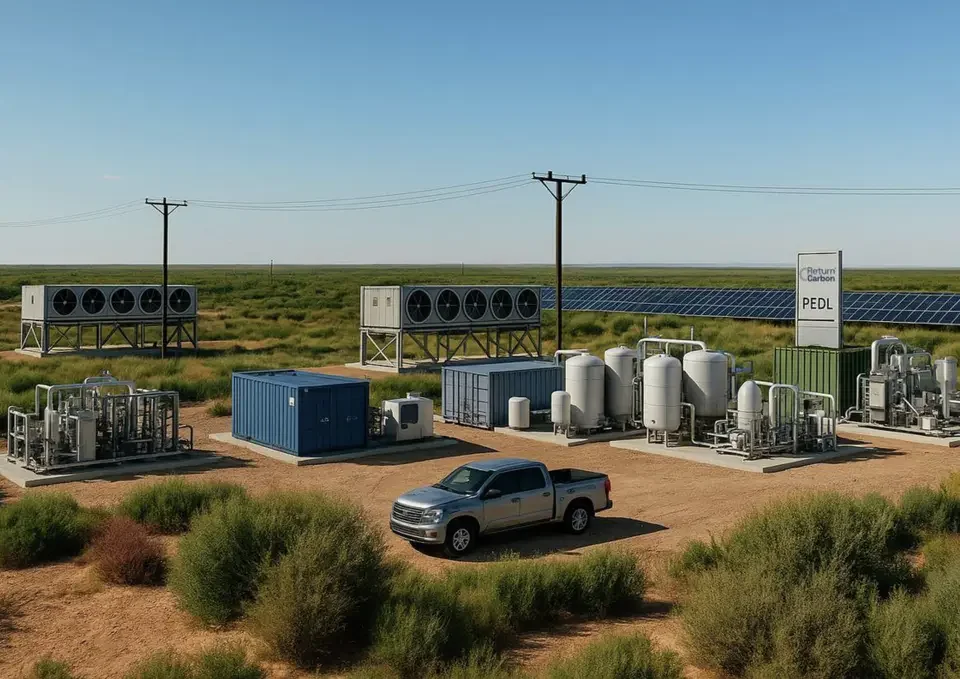
Illustration of the proposed Trinity Campus facility
Approximately 320 acres in Yoakum County are home to a flagship initiative of the Permian Energy Development Lab.
That initiative, the Permian Integrated Energy System, designed to integrate renewables, carbon removal, water reuse and other advanced technologies, will soon house the Trinity Campus, a Direct Air Capture (DAC) and carbon storage testbed to test and validate emerging DAC technologies under real-world field conditions.
“This gives parties a way to test their technology to see what tests best and then lets us scale up,” explained Coleman White, who leads commercial development and project origination at Return Carbon. Return Carbon and the lab are collaborating on Trinity Campus, which is expected to be in operation by mid-2026. Trinity Campus is also enabled by a partnership with Roosevelt Resources.
The lab and Roosevelt Resources are collaborating to support operations at the Trinity Campus, including the integration of power and pilot-scale water treatment systems to enable testing and demonstration of emerging technologies. Roosevelt Resources is also advancing an innovative enhanced oil recovery and carbon sequestration initiative, which is anticipated to serve as the initial storage pathway for captured CO2.
“We’re able to test these technologies and have real data,” White told the Reporter-Telegram.
“The idea is to create a template of integrated systems that can be replicated across the Permian Basin,” said Derek Adams, managing director of the PIES initiative, “and ultimately accelerate their commercialization and deployment.”
Continue reading on the Midland Reporter-Telegram website >>